
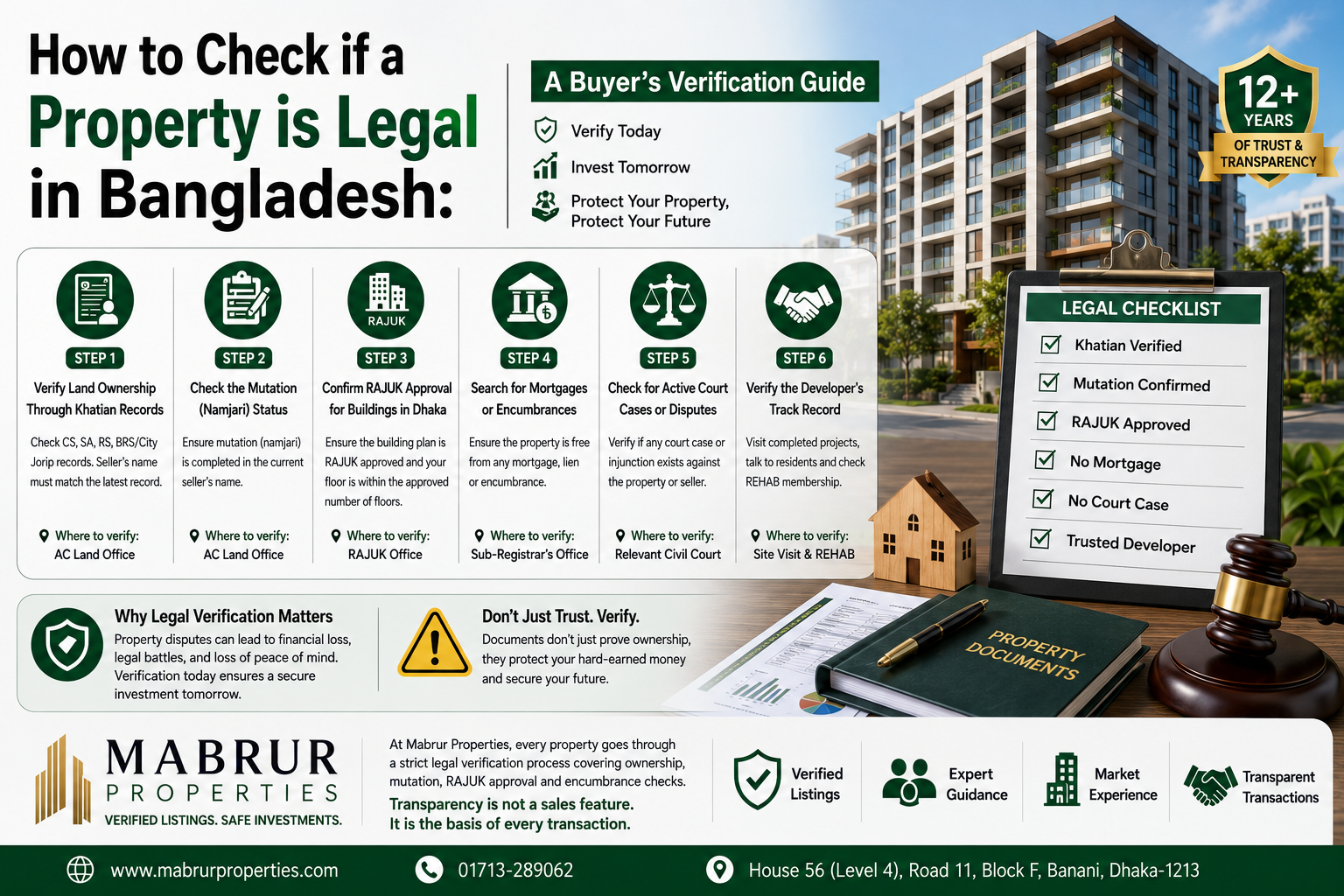
How to Check if a Property is Legal in Bangladesh: A Buyer's Verification Guide
Why Legal Verification Matters More Than You Think
Step 1: Verify Land Ownership Through Khatian Records
Every piece of land in Bangladesh has a recorded ownership history tracked through government survey records called Khatian. There are four main surveys — CS (Colonial Survey), SA (State Acquisition), RS (Revisional Survey), and BRS (Bangladesh Revisional Survey) — each capturing ownership at a specific point in time.
What to check: Ask the seller for all Khatian documents from CS through to the current BRS or City Jorip (for Dhaka city plots). The name of the current seller should match the most recent Khatian record. Any gap or inconsistency in the ownership chain is a serious red flag.
Step 2: Check the Mutation (Namjari) Status
Mutation — locally known as namjari — is the process of updating government land records to reflect the current owner's name after a property transfer. If a seller bought land 10 years ago but never completed mutation, the government's revenue records still show the previous owner's name.
What to check: Ask to see the mutation certificate (namjari sanad) in the current seller's name. If they cannot produce it, ask why. An unmutated property is not necessarily fraudulent, but it adds legal complexity and raises questions about the ownership chain.
Step 3: Confirm RAJUK Approval for Buildings in Dhaka
If you are buying an apartment or any property involving a building structure in Dhaka, RAJUK (Rajdhani Unnayan Kartripakkha) approval is non-negotiable. RAJUK approves building plans before construction begins, specifying the permitted number of floors, setback distances, and land usage.
Many developers in Dhaka construct additional floors beyond what RAJUK approved — creating a situation where part of the building is technically illegal. Buyers of flats on unapproved floors face potential demolition orders, ineligibility for utility connections, and serious difficulties when trying to sell or mortgage the property in the future.
What to check: Ask for the original RAJUK-approved building plan. Confirm that the floor your apartment is on falls within the approved number of floors. The plan approval number can be cross-checked directly with RAJUK.
Step 4: Search for Mortgages or Encumbrances
A property can be legally mortgaged to a bank or financial institution while being simultaneously offered for sale. If you purchase a mortgaged property without knowing, you inherit the seller's debt obligation — and the bank retains a legal claim over the asset.
What to check: Request a certified copy of the tawsil (land revenue receipt) confirming the seller is paying current land tax. Ask directly whether the property is under any mortgage or loan. More importantly, verify this independently.
Where to verify: The Sub-Registrar's office maintains records of registered mortgages and encumbrances. A title search conducted by a lawyer at the relevant Sub-Registrar's office will reveal whether any mortgage, lien, or court injunction is registered against the property. This search typically takes 2–3 working days and is worth every taka.
Step 5: Check for Active Court Cases or Disputes
Some properties are under active litigation — family disputes over inheritance, boundary disagreements between neighbours, or cases filed by previous owners contesting a sale. A court injunction (stay order) can legally block a property transfer even after money has changed hands.
What to check: Ask the seller directly whether any court case involves the property. Then verify independently — a lawyer can search case records at the relevant civil court for cases filed against the property's dag (plot) number or the seller's name.
This step is especially important for land purchased in areas with rapid development pressure — Savar, Gazipur, Keraniganj — where boundary disputes and inheritance conflicts are more commonly litigated.
Step 6: Verify the Developer's Track Record for Apartment Purchases
For apartment buyers, the legal status of the land is only one part of the picture. The developer's credibility matters just as much.
What to check: Ask whether the developer is registered with REHAB (Real Estate and Housing Association of Bangladesh). More importantly, visit at least one completed project by the same developer. Talk to residents. Ask whether the developer delivered on time, whether the building quality matched what was promised, and whether post-handover service issues were handled responsibly.
A developer with a clean land title but a history of delayed or substandard delivery creates a different kind of legal and financial risk — one that documents alone cannot reveal.

