
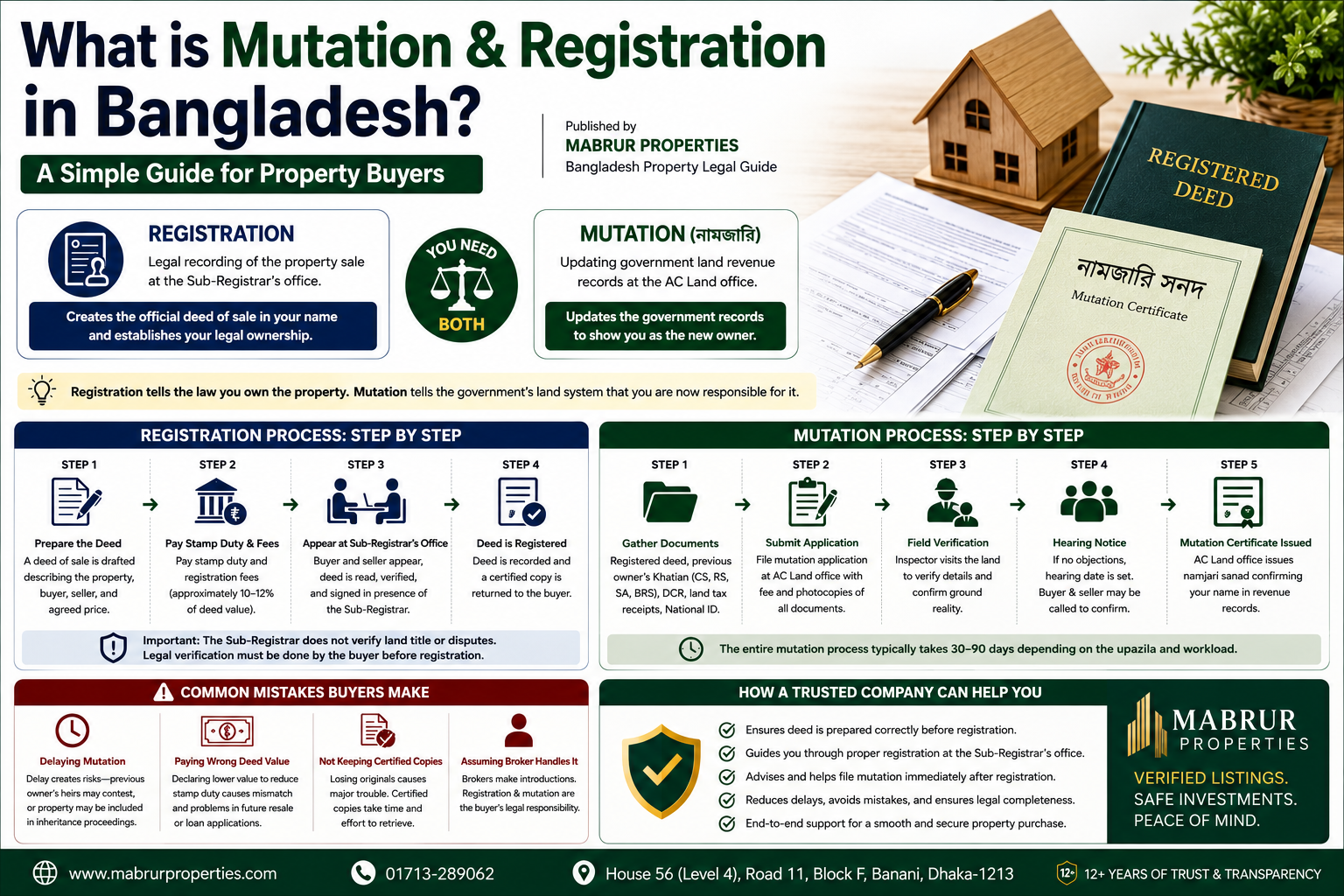
What is Mutation & Registration in Bangladesh? A Simple Guide for Property Buyers
Published by Mabrur Properties | Bangladesh Property Legal Guide
Registration and Mutation: Two Different Things
The single most important thing to understand is this: registration and mutation are separate legal processes, handled by different government offices, and both are required to fully complete a property transfer in Bangladesh.
Many buyers complete registration and consider themselves done. They are only halfway there.
Registration is the legal recording of the property sale at the Sub-Registrar's office. It creates the official deed of sale in your name and establishes your legal ownership of the property under the Registration Act.
Mutation (নামজারি — namjari) is the updating of the government's land revenue records to reflect the new owner's name. It is handled by the AC Land office and is required for paying land tax, future resale, and legal completeness of ownership.
Think of it this way: registration tells the law you own the property. Mutation tells the government's land administration system that you are now responsible for it. You need both.
What is Registration — And How Does It Work?
Registration is the formal, legal transfer of property ownership through a registered deed of sale (dastawej). Without registration, a sale agreement or even a payment receipt does not constitute legal ownership in Bangladesh.
Step 1 — Prepare the deed: A deed of sale is drafted — typically by a deed writer (deed lekhak) or lawyer — describing the property, the buyer, the seller, and the agreed sale price.
Step 2 — Pay stamp duty and fees: Before registration, stamp duty and registration fees must be paid. These currently total approximately 10–12% of the deed value and are paid at the relevant bank or government treasury.
Step 3 — Appear at the Sub-Registrar's office: Both the buyer and seller (or their authorized representatives via Power of Attorney) must appear in person at the Sub-Registrar's office for the relevant area. The deed is read, verified, and signed in the presence of the Sub-Registrar.
Step 4 — Deed is registered: The Sub-Registrar records the deed in the official register and returns a certified copy to the buyer. This registered deed is your primary proof of legal ownership.
Important: The Sub-Registrar does not verify whether the land title is clean or disputed — they only record that a transaction took place. Legal verification of documents must be done by the buyer before reaching this step.
What is Mutation — And Why Is It Separate?
Mutation is the process of updating the Khatian (land record) at the AC Land office to replace the previous owner's name with yours. In Bangladesh, land revenue records are maintained separately from sale registration records — which is why the two processes are handled by two different offices.
Until mutation is completed, the government's land records still show the previous owner as the responsible party for that plot. This creates several practical problems:
You cannot pay land tax (khajna) in your own name — and unpaid tax can accumulate as arrears against the property.
Future buyers or banks financing a loan will see a mismatch between your registered deed and the revenue records, causing delays and complications.
In any legal dispute involving the land, an unmutated title weakens your position even if your registered deed is valid.
How to Complete Mutation: Step by Step
Step 1 — Gather your documents: You will need the registered deed of sale, the previous owner's Khatian (CS, RS, SA, BRS), the DCR (Duplicate Carbon Receipt from registration), recent land tax receipts, and your National ID card.
Step 2 — Submit a mutation application: File a formal application at the AC Land office (upazila bhumi office) for the relevant area. The application includes a set fee and must be accompanied by photocopies of all supporting documents.
Step 3 — Field verification: The AC Land office assigns an inspector to verify the land physically and confirm the details in the application match the ground reality. This visit is routine for most straightforward cases.
Step 4 — Hearing notice: If there are no objections or disputes, a hearing date is set. Both the buyer and seller (or their representatives) may be called to confirm the transaction.
Step 5 — Mutation certificate issued: Once approved, the AC Land office issues the mutation certificate (namjari sanad) — confirming that the government's revenue records now show your name as the owner.
The entire mutation process typically takes 30–90 days depending on the upazila and workload. Starting it immediately after registration is strongly recommended.
Common Mistakes Buyers Make With Registration and Mutation
Delaying mutation after registration: There is no strict legal deadline for mutation in all cases, but delay creates practical risks — including the possibility of the previous owner's heirs contesting the transfer, or the property being incorrectly included in inheritance proceedings.
Paying the wrong deed value: Some buyers declare a lower property value in the deed to reduce stamp duty. Beyond being legally problematic, this creates a mismatch between the actual transaction and official records that can cause difficulties in future resale or loan applications.
Not keeping certified copies: The registered deed and mutation certificate must be stored safely. Losing originals causes significant administrative difficulty — certified copies from the relevant offices are obtainable but take time and effort to retrieve.
Assuming the broker handles it: Brokers facilitate introductions. Registration and mutation are the buyer's legal responsibility. Unless you have explicitly engaged a lawyer or trusted company to handle these steps on your behalf, do not assume someone else is taking care of them.

