
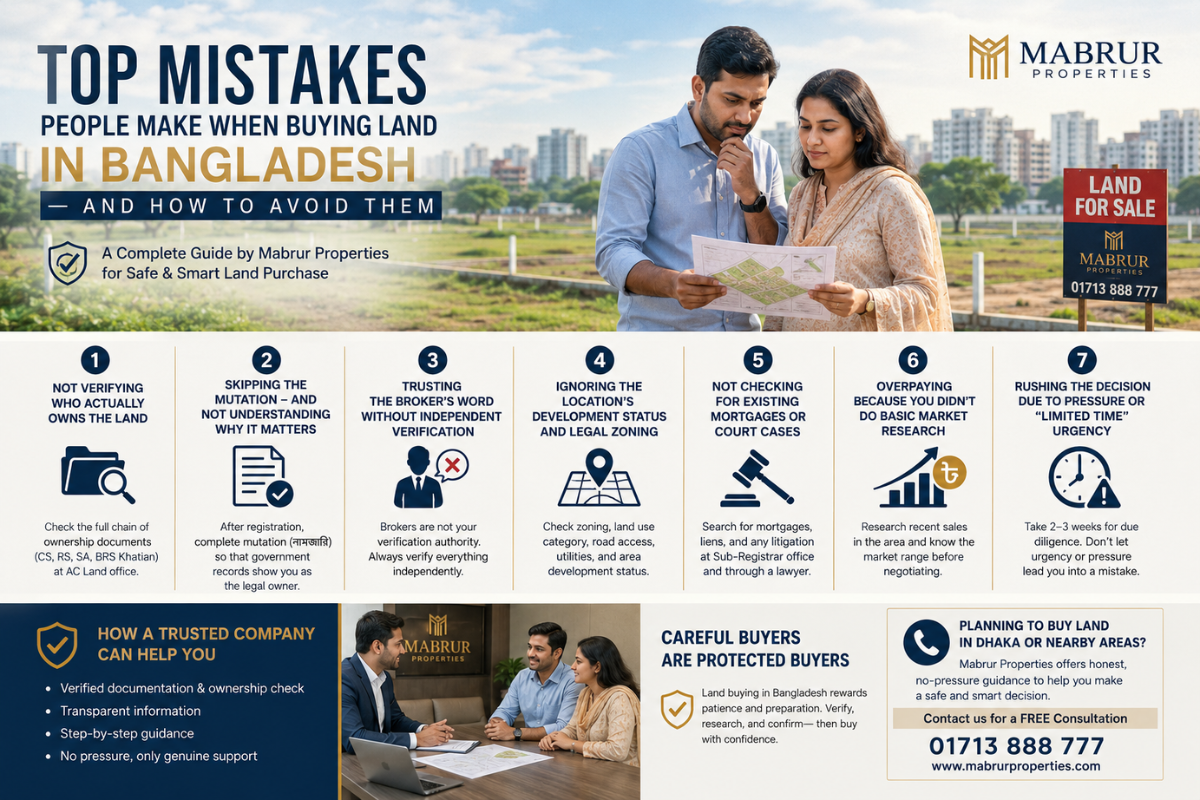
Top Mistakes People Make When Buying Land in Bangladesh — And How to Avoid Them
Published by Mabrur Properties | Bangladesh Real Estate Guide
Mistake 1: Not Verifying Who Actually Owns the Land
This is the single most dangerous mistake in land buying in Bangladesh — and the most common.
Land ownership in Bangladesh is tracked through a series of government records called Khatian (CS, RS, SA, and BRS). Each survey recorded land ownership at a specific point in history. The problem? Many sellers present only the most recent document while hiding disputes, multiple ownership claims, or family partition issues buried in older records.
What to do: Before paying a single taka, ask for the full chain of ownership documents — from CS Khatian down to the current mutation. Cross-check the current owner's name against the latest RS or BRS Khatian. Better yet, visit the local AC Land office to verify independently. Never rely solely on documents the seller hands you.
Mistake 2: Skipping the Mutation — and Not Understanding Why It Matters
Many buyers celebrate after registration and consider the job done. But in Bangladesh, registration alone does not complete the legal transfer of land. Mutation (নামজারি) is the process of updating the government's land record in your name after purchase. Without mutation, the land officially still appears under the previous owner's name in revenue records.
This creates a practical problem: you won't be able to pay land tax (khajna) in your own name, and future buyers may question the legitimacy of your ownership.
What to do: After completing your deed registration at the Sub-Registrar's office, file for mutation at the local AC Land office within the prescribed time. Keep the mutation certificate safely — it is proof that government records now reflect you as the lawful owner.
Mistake 3: Trusting the Broker's Word Without Independent Verification
Bangladesh's land market runs significantly on informal brokers — dalals — who may have useful local knowledge but also have a financial incentive to close the deal quickly, regardless of problems with the land.
A buyer in Savar once shared how his broker swore the land had no disputes, only for the buyer to discover after purchase that a small portion of the plot had been acquired by the government for a road expansion project. The broker had known. The buyer had trusted.
What to do: Use a broker as a lead source, not as your verification authority. Every claim a broker makes should be independently confirmed — through documents, through the AC Land office, and ideally through a qualified lawyer. A broker's word, however confident, is not a legal safeguard.
Mistake 4: Ignoring the Location's Development Status and Legal Zoning
A plot of land near Uttara Extension or Purbachal might look attractive on a map, but without checking its zoning classification, you could be buying land that is legally restricted for the use you have in mind. Agricultural land, for instance, cannot simply be used for residential construction without official reclassification. Similarly, some areas near Dhaka fall under flood-prone or ecologically sensitive zones that have building restrictions.
Beyond zoning, location development matters for practical value. Buyers in Gazipur and Savar have sometimes purchased land based on promises of an upcoming road or utility connection — only to wait years with no progress, leaving the land effectively inaccessible and unsellable.
What to do: Check with RAJUK (for Dhaka-area land) or the relevant authority in other districts to confirm the land's zoning category and any development restrictions. Research actual road access, utility availability, and the realistic development timeline of the area before committing.
Mistake 5: Not Checking for Existing Mortgages or Court Cases
Land can be mortgaged to a bank or financial institution while still being offered for sale. In some cases, sellers facing financial pressure sell mortgaged land without disclosing the loan. The buyer gets the deed — but so does the bank's claim. In other cases, land may be under active litigation between family members or disputed parties, with a court injunction that restricts its transfer.
What to do: Request a certified copy of the Tawsil (land revenue receipt) and check for any encumbrances at the Sub-Registrar's office. A lawyer can do a title search to identify if the land is under mortgage or pending litigation. This step takes a few days but can save you from a legal nightmare that lasts years.
Mistake 6: Overpaying Because You Didn't Do Basic Market Research
Land prices in Bangladesh vary dramatically — not just by district, but by mouza, by road access, by plot shape, and even by which direction the plot faces. Buyers who don't research the local market often pay 20–30% more than the going rate, simply because they had no benchmark.
In areas like Uttara Sector 18, Ashiyan City, or Purbachal New Town, prices can vary significantly from one block to another based on proximity to main roads, commercial zones, or completed infrastructure.
What to do: Before negotiating, research recent land sales in the same mouza through local contacts, the Sub-Registrar's office records, or a property professional familiar with the area. Know the market range before you sit across from a seller.
Mistake 7: Rushing the Decision Due to Pressure or "Limited Time" Urgency
A common tactic in Bangladesh's informal land market is artificial urgency — "another buyer is coming tomorrow," or "the price goes up next week." First-time buyers, afraid of missing out, skip verification steps and pay quickly. This is exactly the environment where fraud thrives.
Genuine sellers with clean land rarely pressure you to decide within 24 hours. Urgency is often a red flag, not a reason to hurry.
What to do: Give yourself at least two to three weeks for any land purchase — enough time to verify documents, check government records, consult a lawyer, and visit the land more than once at different times. If a seller refuses to wait for reasonable due diligence, consider that refusal your answer.
How a Trusted Company Can Help You Avoid These Mistakes
Navigating land purchase in Bangladesh alone — especially for the first time — is genuinely difficult. The documentation process is complex, the risks are real, and the cost of a mistake is high.
This is where working with a reliable real estate company changes the experience entirely.
Mabrur Properties has spent over 12 years helping middle-income buyers and first-time purchasers in Dhaka — particularly in and around Uttara — make safe, informed property decisions. Their approach centers on three things that matter most in land buying: verified documentation, transparent information, and step-by-step guidance.
Every property Mabrur Properties presents has gone through an internal documentation review. Buyers get clear information about ownership records, plot status, and any area-specific considerations — without the guesswork. For buyers who feel overwhelmed by the legal and administrative side of land purchase, having a knowledgeable team walk alongside them through the process makes an enormous practical difference.
There's no pressure involved. The goal is simply to help you make a decision you'll feel confident about — not just on the day of purchase, but years later.

