
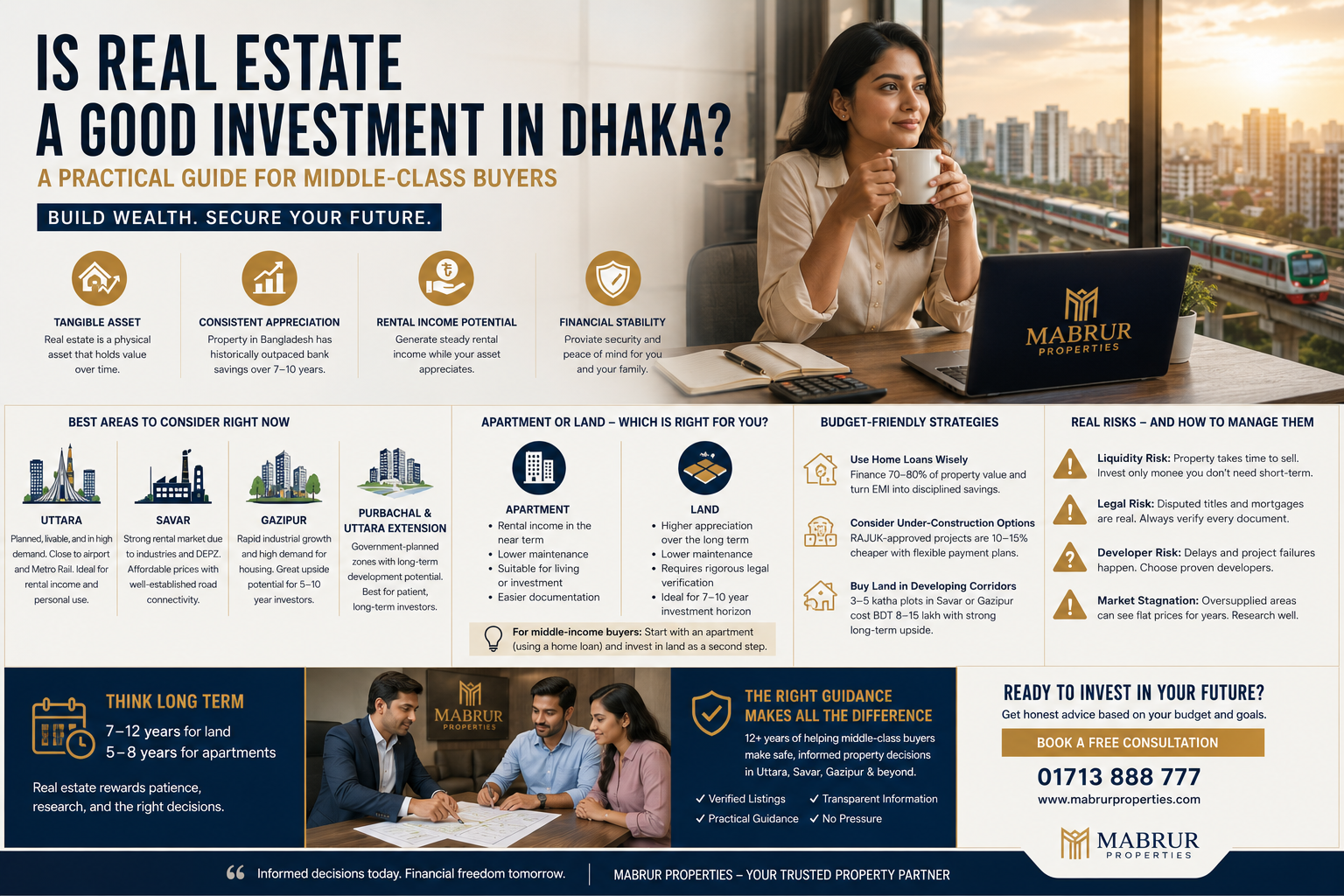
Is Real Estate a Good Investment in Dhaka? A Practical Guide for Middle-Class Buyers
Published by Mabrur Properties | Bangladesh Property Investment Guide
Why Real Estate Remains One of the Strongest Investments in Bangladesh
Bangladesh's economy has grown consistently over the past two decades, and with it, the demand for urban housing and commercial space has surged. Unlike many financial instruments, real estate is a tangible asset — it doesn't disappear in a market crash, it doesn't lose value overnight, and it can generate income while you hold it.
Property in Bangladesh has historically appreciated at a rate that outpaces standard bank savings over a 7–10 year period. Land in particular tends to hold value even during economic slowdowns, because supply is fixed while population and urbanization keep growing. For middle-income professionals, owning property also provides something a savings account cannot — financial stability and a long-term anchor.
Dhaka's Property Market: What You Need to Know
Dhaka is one of the most densely populated cities in the world, and its urban boundary keeps expanding. Areas that were considered far from the city a decade ago — like Savar, Gazipur, and Keraniganj — are now actively developed residential zones with schools, hospitals, and road connectivity.
This expansion is not accidental. Infrastructure projects like the Dhaka Elevated Expressway, MRT (Metro Rail) lines, and the Dhaka-Mymensingh highway expansion have fundamentally changed how the city grows. Areas near metro stations and major road corridors have seen property values increase significantly — and this trend is still in motion. For middle-class buyers, this means real opportunities exist not just in central Dhaka but in strategically positioned peripheral areas where prices are lower and upside potential is higher.
Best Areas to Consider Right Now
Choosing the right location is the most important decision in any property investment. Here is a realistic look at where value exists for middle-income buyers:
Uttara (Dhaka): One of the most planned and livable areas of Dhaka, Uttara offers consistent demand from renters and buyers alike. Its proximity to the airport, Metro Rail connectivity, and organized sector layout make it reliable for both personal use and rental income. Prices are higher than peripheral areas, but so is the stability.
Savar: With the presence of garment industries, DEPZ (Dhaka Export Processing Zone), and Jahangirnagar University, Savar has a consistently strong rental market. Land and apartment prices remain more accessible than central Dhaka, and road connectivity via the Dhaka-Aricha highway is well established.
Gazipur: The city's rapid industrial and commercial growth has driven significant housing demand. The Tongi-Gazipur corridor in particular has seen steady appreciation over the past five years. For buyers with a 5–10 year horizon, this area offers genuine upside without requiring a large initial budget.
Purbachal and Uttara Extension: Government-planned new towns with long-term development potential. These suit patient investors comfortable waiting 5–10 years for infrastructure to mature. Not ideal for short-term thinking, but compelling for long-term wealth building.
Apartment or Land — Which Makes More Sense for You?
This is one of the most common questions among first-time investors, and the honest answer depends on your goal and timeline.
Apartments are more suitable if you want rental income in the near term, prefer a lower-maintenance investment, or plan to live in the property yourself. A well-located apartment in Uttara or Mirpur can generate steady monthly rental returns while appreciating in value. The documentation and legal process is also more straightforward than land in most cases.
Land typically offers stronger appreciation over a longer period, particularly in developing zones like Savar, Gazipur, or new town areas. Land requires less ongoing maintenance, but demands more rigorous legal verification upfront and does not generate rental income unless developed.
For buyers earning BDT 50,000–70,000 per month, a practical starting point is often an apartment — using a home loan to manage the upfront cost — and considering land as a secondary investment when more capital is available.
Budget-Friendly Investment Strategies for Middle-Class Buyers
You don't need BDT 1 crore to enter Dhaka's property market meaningfully. Here are strategies that work for mid-budget buyers:
Use home loan leverage wisely. Banks in Bangladesh offer home loans covering 70–80% of property value. A BDT 15–20 lakh down payment can secure an apartment worth BDT 60–80 lakh in areas like Uttara or Mirpur. Structured properly, the monthly EMI becomes a disciplined savings mechanism rather than a financial burden.
Consider under-construction apartments in RAJUK-approved projects. These are typically 10–15% cheaper than ready flats and allow staged payment. The risk is manageable if you verify the developer's completed project track record carefully before committing.
Start with peripheral land in developing corridors. A 3–5 katha plot in the right part of Savar or Gazipur can be purchased for BDT 8–15 lakh depending on exact location. Held for 7–10 years, these have historically seen strong appreciation as infrastructure matures around them.
Real Risks — and How to Manage Them Honestly
No investment is without risk, and anyone who tells you otherwise about real estate is not being straight with you.
Liquidity risk: Property cannot be sold in a day. If you need cash urgently, converting real estate takes time. Only invest money you won't need in the short term.
Legal risk: Disputed titles, undisclosed mortgages, and unapproved construction remain real hazards in Bangladesh's market. Thorough document verification before purchase is not optional — it is the investment itself.
Developer risk: For under-construction properties, a developer's failure to deliver on time is a documented risk. Stick to developers with a verified track record of completed projects.
Market stagnation: In some oversupplied areas, property prices can remain flat for years. Research local demand carefully rather than buying on general optimism alone.
Managing these risks doesn't require expert-level knowledge — it requires patience, the right questions, and the right people helping you ask them.
Long-Term vs Short-Term: Which Mindset Works in Dhaka?
The buyers who consistently do well in Dhaka's property market are the ones who think in years, not months. Real estate in Bangladesh is not a quick-flip asset — transaction costs including registration, tax, and agent fees alone make short-term trading inefficient for most middle-class buyers.
The practical sweet spot is typically a 7–12 year holding period for land and 5–8 years for apartments in growth corridors. Within that window, consistent urban expansion, population growth, and infrastructure development tend to do the heavy lifting. If you're buying with the expectation of doubling your money in two years, property is the wrong instrument. If you're building a foundation of wealth that compounds steadily over a decade — it is genuinely hard to beat.
How the Right Guidance Makes a Difference
The difference between a good property investment and a costly mistake often comes down to one thing: the quality of guidance you have before you commit.
Mabrur Properties has spent over 12 years helping middle-class professionals and first-time buyers navigate Dhaka's property market — particularly in Uttara and nearby areas like Savar and Gazipur. Their value isn't just in listing properties. It's in the verification process behind each listing, the transparent communication about what an area's development actually looks like, and the practical guidance on how to match a buyer's budget and timeline with the right type of investment.
For someone like Nasrin — careful with her money, serious about her future, and trying to make a genuinely informed decision — that kind of advisory relationship is not a luxury. It's the difference between confidence and regret.

